
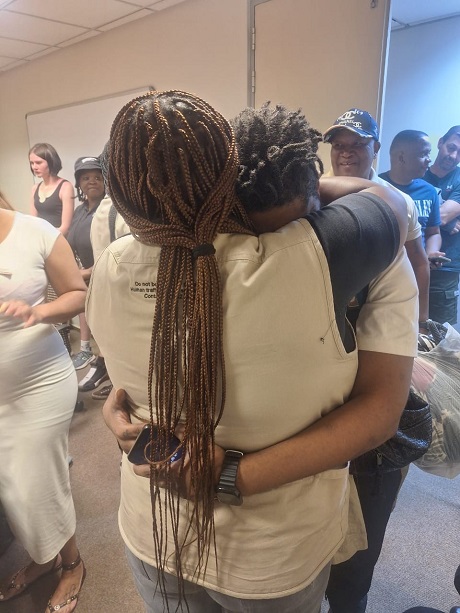
Government Rescues and Repatriates Trafficked South African Youth
The South African government has safely repatriated a group of young people who were trafficked to Southeast Asia under false promises of overseas employment, in what authorities say is part of a growing human trafficking network targeting vulnerable youth.
The Gauteng Department of Social Development has issued a fresh warning to citizens especially young job seekers about fake international job offers, after 17 of the 120 trafficked South Africans were recently brought home. The victims had been lured through Thailand and ultimately exploited in Myanmar. The rescued young people come from across the country, including Mpumalanga, KwaZulu-Natal, Gauteng, Free State, North West and the Western Cape. Gauteng alone accounted for around 80 of the victims, showing just how widespread and organised these trafficking in persons syndicates have become.
The repatriation was coordinated by the National Intersectoral Committee on Trafficking in Persons (NICTIP), which includes government departments responsible for law enforcement, immigration, and social services. Investigations reveal that many of the victims were recruited via social media platforms like Facebook, while others were approached by people they knew including acquaintances, former colleagues, church members, and even relatives. Recruiters conducted so-called “interviews” over WhatsApp or email and offered to cover flights, accommodation, and travel costs. These tactics made the jobs appear legitimate and highly attractive to young people desperate for employment.
One of the repatriated victims, a 25-year-old man who asked to be called “The Don” for safety reasons, arrived at OR Tambo International Airport this week along with five others. He had left South Africa in November 2024 believing he had secured a better future. “I have been the breadwinner for my four siblings since 2022 after my mother passed away and our stepfather disappeared after the funeral,” he said.
After losing his contract job at a fuel distribution company, he began searching for work. That’s when the overseas opportunity appeared. “As a software developer, I was told I would work as a data capturer. We communicated through WhatsApp and email, and everything sounded professional.”
But things quickly took a dark turn. “Even though we were given accommodation and food, the conditions were bad. The first red flag was that they only arranged my visa after I had already arrived. We were also moved between about 30 different cars before reaching our final destination,” he explained.
Victims were reportedly not allowed to contact their families, and punishments and fines were imposed for disobedience. “The breakthrough came when one of the people there died. The area was surrounded by military and police, the place was shut down, and we were rescued,” he said.
Gauteng Social Development Trafficking in Persons (TIP) Coordinator Takalani Sekoba explained that trafficking involves three key elements: recruitment, transportation, and exploitation. Under South Africa’s Prevention and Combating of Trafficking in Persons Act (Act 7 of 2013), trafficking includes recruiting or transporting people through deception, coercion, or abuse of vulnerability for the purpose of exploitation.
This exploitation can include forced labour, sexual exploitation, slavery or practices similar to slavery, servitude, and organ removal. In simple terms, human trafficking is modern-day slavery and a serious violation of human rights affecting people of all ages, genders, and backgrounds. Authorities are urging the public to watch out for red flags linked to job trafficking scams, including recruitment processes with no formal job contract or verifiable company details, interviews conducted only online with no physical office, fully paid travel and accommodation offered upfront, and pressure to leave urgently or keep the opportunity secret. These tactics are especially common during periods when young people are looking for work or preparing for the new academic year.
As the country enters the back-to-school and back-to-tertiary season, government departments are ramping up anti-human trafficking awareness campaigns. Parents, educators, faith-based organisations, and community leaders are being called on to help verify overseas job opportunities before any travel takes place. Members of the public who suspect a human trafficking scam or want to verify a job offer can contact the Trafficking in Persons Resource Hotline on 0800 222 777, the Gender-Based Violence Command Centre (available 24 hours a day) on 0800 428 428, or report the matter to the South African Police Service (SAPS).
Authorities stress that if a job offer sounds too good to be true, it probably is and a quick verification call could save a life.


