Farm Tech Diplomacy China–SA Machinery Ties Promise Jobs, Productivity and New Trade Gains
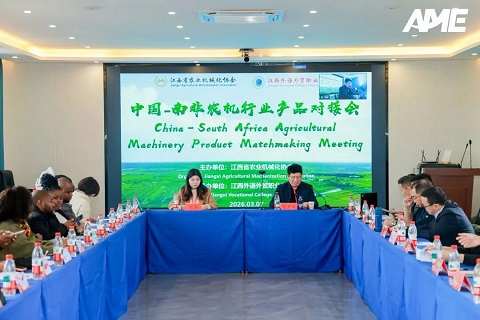
7 March 2026- Agricultural cooperation between China and South Africa is entering a new phase one defined less by diplomacy and more by tractors, drones and the economics of modern farming.This shift was on full display at a recent agricultural machinery product matchmaking meeting held in China’s Jiangxi Province, where a South African delegation explored advanced farm equipment and held direct business talks with Chinese manufacturers.
South African entrepreneurs attending the meeting observed a wide range of equipment, including electric cultivators, rice transplanters, combine harvesters, vegetable harvesters, corn planters and precision plant-protection drones. The demonstrations highlighted how rapidly agricultural technology is evolving and how mechanisation is becoming essential for countries seeking to remain competitive in global food markets.
“This is not just about buying machines,” said one member of the South African delegation. “It is about improving efficiency, reducing costs and making our agriculture sector more competitive internationally.” For South Africa, the stakes are significant. Agriculture remains one of the country’s most resilient economic sectors, contributing strongly to exports, employment and rural livelihoods even during periods of broader economic strain. Access to more affordable and technologically advanced machinery could help farmers boost yields while lowering labour and fuel costs.
Many participants at the Jiangxi meeting said the technology on display was particularly relevant to South Africa’s agricultural structure, which includes both large commercial farms and thousands of emerging and small-scale producers. Compact electric machinery and drones, designed to operate on smaller plots and uneven terrain, were seen as especially suitable for these conditions.
A Johannesburg-based agricultural equipment distributor who attended the meeting said the visit offered practical insight into how local farmers could benefit. “These smaller machines are exactly what we need in South Africa,” the distributor said. “They are efficient, easier to maintain and can help new farmers increase output without the massive costs associated with traditional heavy equipment.”
The matchmaking event was organised to go beyond a standard exhibition. South African delegates were able to hold face-to-face discussions with Chinese manufacturers, compare pricing and technical specifications, and explore possible distribution or partnership agreements. Several entrepreneurs exchanged contact details and initiated talks on future procurement and after-sales support. Chinese companies participating in the event expressed growing interest in the South African market, which is widely regarded as a gateway to the rest of the African continent. Representatives said they are increasingly looking at long-term cooperation rather than one-off exports, including training programmes, technical support and the possibility of local assembly operations.
“We are not only looking to export machines,” a representative from a Jiangxi-based agricultural equipment company said. “We want sustainable cooperation, including technical training and local service centres that can support farmers over time.”The meeting reflects a broader shift in China–South Africa economic relations, where cooperation is moving from large infrastructure projects toward more targeted sectors such as agriculture, technology and manufacturing. As both countries place greater emphasis on food security and rural development, agricultural mechanisation is emerging as a key area of shared interest.
For South Africa, modernising farming is closely tied to economic growth. Increased productivity can translate into higher export volumes, stronger rural economies and improved food supply stability, all of which have knock-on effects for inflation, employment and trade balances. Industry analysts note that mechanisation could also help address labour shortages and rising input costs, two of the biggest pressures currently facing farmers. Drones that can spray crops precisely and electric equipment that reduces fuel dependence are viewed as practical tools to contain expenses while maintaining output.
At the same time, machinery partnerships could generate new economic activity beyond the farm gate. Importing advanced equipment typically requires local distribution networks, spare-parts supply chains, repair workshops and operator training all of which create opportunities for small businesses and skilled jobs. For many of the South African delegates, the visit to Jiangxi was not only about technology but about rethinking the future of agriculture back home. Watching automated planters and drones operating in coordinated sequences, they were reminded that farming is increasingly becoming a data-driven and technology-intensive industry.
As one delegate observed while touring the exhibition grounds, “The future of farming is no longer just about land and rainfall. It is about machines, software and partnerships. What we saw here shows how quickly agriculture is changing and why South Africa cannot afford to be left behind.”