
South Africa and China Deepen Trade Partnership Through New Standards Agreements
South Africa and China have taken another significant step towards strengthening bilateral trade relations, with the signing of a series of Memoranda of Understanding (MOUs) aimed at improving regulatory cooperation, product standards and market access between the two countries.
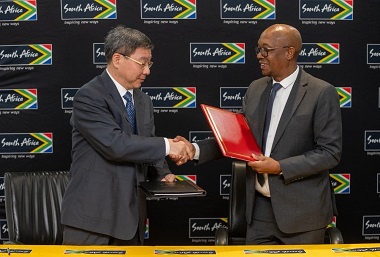
The agreements, signed in Pretoria on 30 June 2026, are expected to play a crucial role in the implementation of the China–South Africa Zero-Tariff Trade Agreement, which came into effect last month and grants qualifying South African exports duty-free access to the Chinese market. Minister of Trade, Industry and Competition, Parks Tau, and China’s Vice Minister of the State Administration for Market Regulation (SAMR), Shu Wei, led the signing ceremony at the Department of Trade, Industry and Competition (the DTIC) headquarters.
The MOUs bring together key regulatory and standards bodies from both countries, including South Africa’s National Regulator for Compulsory Specifications (NRCS), the South African National Accreditation System (SANAS), and the China National Accreditation Service for Conformity Assessment. The agreements are designed to improve cooperation on accreditation, conformity assessments and standards recognition, making it easier for products to move between the two markets while maintaining quality and safety requirements. Speaking at the ceremony, Tau described the agreements as a critical milestone in the growing economic partnership between South Africa and China. “These agreements are not simply administrative arrangements. They represent a practical commitment to improving the quality, efficiency and integrity of trade between our countries,” Tau said.
He stressed that trade facilitation should never come at the expense of quality and consumer protection. “South Africa’s position is clear: trade facilitation must not mean lowering standards. It must mean improving systems, reducing unnecessary duplication and ensuring that technical requirements are applied in a way that supports economic development while protecting consumers,” he said.
Tau noted that exporters often face delays and additional costs when products are subjected to repeated testing and certification processes in different countries. The new agreements aim to address these challenges through greater alignment and mutual understanding of standards and regulatory requirements. “There is a difference between removing unnecessary barriers and abandoning the integrity of our technical requirements. Every product that crosses a border must still demonstrate compliance. What we are doing is creating a more efficient system that benefits businesses, regulators and consumers alike,” he added.
The signing follows the conclusion of the Framework Agreement on the Economic Partnership for Shared Development (CADEPA), signed earlier this year in Beijing. The agreement has opened new opportunities for South African exporters by allowing a wide range of products to enter the Chinese market without customs duties. Tau highlighted several strategic sectors expected to benefit from the enhanced cooperation, including automotive components, new energy vehicles, renewable energy technologies, agro-processing and medical devices. “These sectors are central to South Africa’s industrial development ambitions and are also areas where trade between our two countries continues to grow. By improving regulatory cooperation, we can unlock new opportunities for investment, innovation and job creation,” he said.
China’s Vice Minister Shu Wei welcomed the strengthened partnership, saying regulatory cooperation would help create a more predictable and efficient trading environment for businesses in both countries. The two governments have also agreed on a practical work programme that will focus on reducing duplicate testing requirements, comparing technical standards, strengthening engagement between regulators and accreditation bodies, and establishing mechanisms to resolve compliance-related challenges. Business leaders and trade experts have welcomed the move, noting that smoother regulatory processes can significantly reduce costs for exporters while improving competitiveness in international markets.
As South Africa seeks to expand exports and attract investment, the latest agreements are expected to support broader economic cooperation with China, one of the country’s largest trading partners. Officials from both countries expressed confidence that the new framework will help translate the benefits of the zero-tariff agreement into tangible opportunities for businesses and consumers, while reinforcing a long-term partnership built on shared development and mutual economic growth.


