Emeris Ruimsig Students Lead ‘Know Your Rights’ Human Rights Day Initiative
By Thembi Moyo
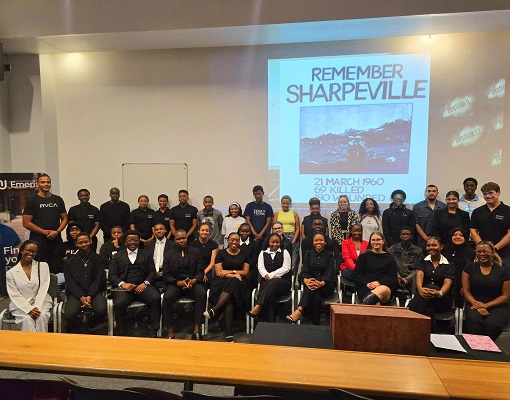
Students and lecturers at Emeris Ruimsig marked Human Rights Day with a powerful and reflective initiative titled “Know Your Rights,” bringing together BCom Law and Higher Certificate in Legal Studies cohorts.The event opened with a moving reflection by Ragiema Samsoiden, who grounded the day in South Africa’s history and its ongoing relevance.“Today, as we commemorate Human Rights Day, we reflect on a painful yet powerful moment in our history the Sharpeville Massacre,” she said. “On that day, peaceful protestors stood against unjust pass laws, only to be met with violence. But that tragedy did not silence the call for justice it ignited global awareness and intensified the struggle for freedom.”
She also reminded attendees of the historic 1956 women’s march to the Union Buildings, where 20,000 women stood united against the extension of pass laws. “The strength and unity of women like Lilian Ngoyi, Helen Joseph, Rahima Moosa and Sophia Williams-De Bruyn showed us what courage looks like,” she said. Quoting the iconic protest chant, she added: “Wathint’ abafazi, wathint’ imbokodo!” a reminder of the enduring strength of resistance. Samsoiden emphasised that human rights have evolved over time and continue to grow with society. “As we honour those who suffered and sacrificed, we must remember that human rights are not static,” she said. “It is our responsibility to protect, promote and advance them for future generations.”
The event went on to unpack the evolution of human rights from civil and political freedoms to socio-economic and collective rights — encouraging students to see these not just as theory, but as lived realities. Lecturer Camielle Goldstone emphasised the importance of civil and political rights in shaping democracy. “These rights are the foundation of democracy. They protect our freedom and ensure that every person is treated with dignity and equality before the law,” she said. “In South Africa, where people were once denied these basic rights, it is important that we understand them and never take them for granted.”
She also highlighted how easily dignity can be overlooked in everyday interactions. “Human dignity is something we often violate without even realising it,” Goldstone said. “Whether through our actions or our words, we can strip someone of their dignity in a moment. That is why respect must guide how we treat one another.” Fellow lecturer Rael Bryant focused on socio-economic rights, highlighting ongoing challenges in society. “Freedom is not only about having a voice, but also about having access to basic needs like housing, healthcare and education,” Bryant said. “These rights require action from the state, but also awareness from citizens so that we can hold systems accountable.”
He added that the responsibility to uphold human rights extends to everyone. “Even today, we see situations where the right to life and dignity is questioned,” he said. “Our responsibility is to ensure that these rights are protected for everyone, under all circumstances.” Students who attended the event said the experience was both eye-opening and personal. As young people, we sometimes think human rights are just something we study,” said one first-year student. “But today made me realise that these rights affect how we live every day how we treat others and how we expect to be treated.”
The programme also explored collective rights, including environmental protection and cultural identity, reminding attendees that human rights extend beyond individuals to communities and future generations. As the event concluded, students were reminded of their role not just as learners, but as future legal professionals and active citizens. As we continues to resonate that the fight for dignity, equality and justice is ongoing, and that the next generation has both the power and responsibility to carry it forward.